Next cycle · Q1 2027
Hospitality · Front of House
Servers, cashiers, bussers. Sponsored by Upshift across established U.S. operations.
Wage range
$14–$15/hr
Our current recruitment cycle is closed. We plan to open the next one in the first quarter of 2027. EB-3 is the U.S. employment-based immigrant visa for entry-level, non-medical workers. For qualified international candidates, it leads to a real U.S. job and lawful permanent residency — for you, your spouse, and unmarried children under 21. Check your eligibility now and we will contact you when the cycle opens.
Most Solutions also helps U.S. companies hire permanent workers from abroad for full-time, entry-level jobs through the EB-3 green card. The company is the sponsor, and experienced U.S. immigration counsel handles the filings.
Net immigration to the U.S. per year. 2026 is a Census estimate.
The number of employers sponsoring entry-level jobs more than doubled since 2023.
Are your competitors doing it?
Up to 40,000 EB-3 green cards a year, 10,000 of them for unskilled jobs.
Sources: U.S. Census Bureau, Vintage 2025. Retirement Income Institute, 2024. U.S. Department of Labor, employers with approved entry-level labor certifications, fiscal years 2023 to 2025. Green card limits: U.S. immigration law (INA 203(b)(3)).
Servers, cashiers, and bussers. Kitchen prep and line work. Warehouse and greenhouse roles. All entry-level. All training-provided. All include EB-3 visa sponsorship from established U.S. employers. Our current cycle is closed — the next recruitment cycle is planned for Q1 2027.
Servers, cashiers, bussers. Sponsored by Upshift across established U.S. operations.
Kitchen helpers, prep, dish, line work. Sponsored by Upshift at real, ongoing food-service operations.
Picking, packing, production. Sponsored by Upshift at established U.S. operations.
Role categories and wages reflect our most recent cycle; the Q1 2027 roster will be confirmed when the cycle opens. Wages shown are prevailing-wage floors set by the U.S. Department of Labor; actual pay can be higher based on shift and location.
Full-time employment with Upshift — same labor protections, overtime rules, and minimum wage floors as any U.S. citizen working the same role.
Your prevailing wage is set by the U.S. Department of Labor before recruitment even starts — and your sponsor cannot pay you below it. Actual pay can be higher based on shift, location, or tenure.
Spouses and unmarried children under 21 come with you on the same EB-3 application. One paperwork process. One household crossing the border together.
EB-3 is an immigrant visa pathway designed to lead to U.S. permanent residency if approved. Final visa approval is determined by U.S. government authorities at every stage of the process.
An EB-3 case typically takes four to five years to complete. Small single-location employers — a single restaurant, a single facility, a handful of employees — often cannot sustain a sponsorship that long. Closures, role changes, or missed compliance steps can end a case midway. Established U.S. employers operating at real scale are substantially more likely to maintain the sponsorship through the full process. For this reason, the program partners only with sponsors that meet that operational standard. Upshift is the current sponsor on this program.

Having reviewed thousands of immigration cases over my career, the biggest cause of EB-3 denial isn't the applicant — it's the sponsor. That's why I only work with established employers.
Real, ongoing employer demand. Our next recruitment cycle is planned for Q1 2027. We built this pathway around international candidates because the worker profile our employer partner needs — industrious, service-oriented, long-term — is exactly who EB-3 lets them sponsor.
Upshift is a U.S. staffing operator backed by Recruit Holdings — the parent company of Indeed and Glassdoor — with hiring activity across multiple U.S. states. It is a large employer operating at real scale.

Upshift has spent nearly a decade hiring across U.S. hospitality, food service, and industrial operations. Its core challenge is the same one every employer in this part of the economy faces: finding workers who show up, take the work seriously, and stay for the long term.
When they looked at how to fill that profile reliably, the answer was international recruitment: motivated candidates who treat these as long-term careers, not stopgaps. A strong service orientation. Family-first values that translate directly into reliability on the job. The work ethic these roles demand, from people who are in it for the long haul.
Upshift's founders come from immigrant family backgrounds themselves. That's part of why they're personally committed to bringing international candidates into multi-year U.S. sponsorship — not as one-off hires, but as long-term employees with a real path forward.
A direct message from our employer partner is in the video.
EB-3 is a four-to-five-year case. Three parties handle it together — Most Solutions (recruitment, case management, and relocation support), the employer sponsor (Upshift), and independent immigration counsel. The same team is with you from your eligibility review through your arrival in the U.S., with regular status updates throughout so you always know where things stand.
Most Solutions is the U.S.-based program coordination and relocation support partner behind this EB-3 pathway. We help qualified international candidates connect with established U.S. employers, run case management end-to-end, and coordinate arrival logistics. From your first eligibility call through your first day on the job in the U.S., one team is with you — with regular status updates at every milestone of your 4–5 year case.
An established U.S. employer is the sponsor behind this program. It has been vetted for the operational stability and ongoing hiring volume needed to support a multi-year EB-3 case.
Senior U.S. immigration attorney handling employer-side EB-3 filings (PERM, I-140) for the Most Solutions program.
Applicant-side filings on this program are reviewed by a senior U.S. immigration attorney with deep, hands-on EB-3 experience — not generalists, not delegated to paralegals.
Short, informational videos covering the parts of EB-3 candidates most often ask about. Recorded by Most Solutions' immigration counsel as general education — not legal advice and does not create an attorney-client relationship with you.
Note: These videos are educational only. Nothing here constitutes legal advice or creates an attorney-client relationship. Candidates may engage their own immigration counsel for case-specific guidance.
Most EB-3 cases fail because the sponsor fails. The parts of that risk that we control go directly into your contract. Final visa approval still rests with the U.S. government, but on our side, here's what we commit to.
If your sponsor can no longer continue your case and we cannot place you with another employer in our network within 6 months — you get every dollar you've paid us back.
If your case is denied because of a recruitment, filing, or paperwork error on our side, we refile your case at no additional cost. We don't lose cases on the parts we control.
We will not promise a 2-year timeline. We will not promise a specific facility, manager, or schedule within your approved work location. We will not promise green card approval. Anyone who does is either lying or doesn't understand the law.
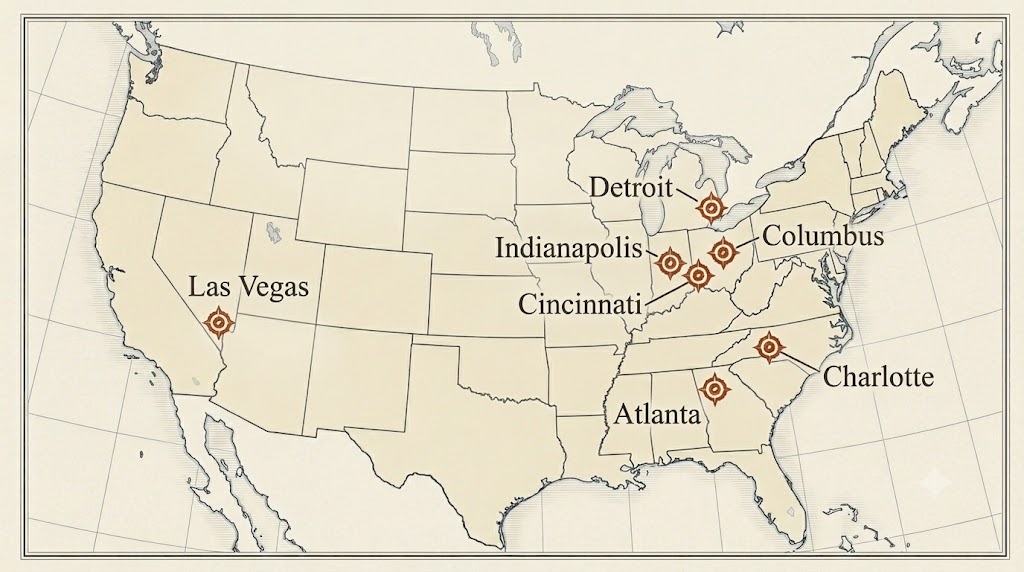
In our most recent cycle, roles were concentrated in Ohio (Cincinnati), with smaller allocations split across Atlanta, Detroit, Charlotte, and Las Vegas. The Q1 2027 city list will be confirmed when the cycle opens. When you sign, you commit to one city + one role category. If your preferred city is full, we'll place you on the next-cycle wait list or offer an alternate city you've pre-approved.
The EB-3 pathway typically takes four to five years from sponsor match to arrival in the United States. The timeline is governed by U.S. government processing and the visa bulletin — not by us. Below is the stage-by-stage breakdown, including the three points where most EB-3 cases are denied and how we work to prevent each one.
You're matched with an established employer partner — such as Upshift — in your chosen city. The sponsor is real, the role is committed, the prevailing wage is set.
Your sponsor's recruitment runs first — U.S. workers must legally be given the chance to apply. Our team runs it by the book. This is where most EB-3 cases get denied. We don't lose cases here.
Required: your sponsor's tax returns showing ability to pay your wage. We verify sponsor readiness before accepting candidates into the program.
Your interview at the U.S. consulate. We prep you one-on-one — what they ask, how to answer, what documents to bring. Then you arrive and start work.
Total expected time today: approximately 4–5 years from sponsor match to arrival in the U.S.
EB-3 is an immigrant visa pathway designed to lead to U.S. permanent residency if approved. Final visa approval is determined by U.S. government authorities. Specific timelines and outcomes depend on your case and current U.S. immigration policy.
When your visa clears, our team is on the other side to help you settle in. The first six months in the U.S. are the most important — getting them right is part of the program.
A pre-arranged driver meets you at arrival with a sign with your name on it, and takes you to your first-night accommodation.
The neighborhood around your worksite — apartments, transit, grocery, gym, places of worship — sent to you weeks before you land.
A point of contact by phone, WhatsApp, or email for your first six months — from setting up a bank account to navigating a delayed first paycheck.
Through the long middle of the process, you'll get a status update every month. Predictable, structured communication.
From your first eligibility call through your first day on the job in the U.S., one team coordinates your case end-to-end. Spouse and unmarried children under 21 are included on the same case. Program cost is explained on your free eligibility call — after we confirm you fit the program, and before you commit to anything.
Matching you with Upshift or another partner employer in the network. City and role category locked in before you sign. Sponsor agreement coordination.
Legal coordination on the applicant side of the case — DS-260 consular processing support and document support. PERM labor certification and I-140 employer-side filings are paid for by the employer per U.S. Department of Labor rules — not by you. Government filing fees on the applicant side are paid separately by you.
One dedicated point of contact for the whole case. Monthly status updates. Help gathering civil documents, translations, certifications, and everything the consulate needs.
One-on-one consular interview prep with our immigration counsel before you sit in front of a U.S. State Department officer. On arrival: airport pickup, housing map sent before you fly, and six months of post-arrival support.
Final visa approval is always decided by the U.S. government — no honest company can promise it. What we can promise is the part we control. On the sponsor side — the biggest single risk in any EB-3 case — we only work with established U.S. employers vetted by independent immigration counsel over years of case work, before any candidate signs. And if your sponsor can't continue your case and we can't replace them within 6 months, every dollar you've paid is refunded. We only take on cases we believe we can run successfully.
Four to five years from signing your contract to arriving in the United States. Anyone promising you a shorter timeline is either incorrect or describing a different visa entirely.
The U.S. government publishes a "visa bulletin" each month showing which cases are being processed. Right now, the applicants getting interview notices submitted their paperwork in early 2022 — that's about four years and three months ago. So four to five years is the realistic floor.
Upshift, which hires across multiple U.S. states and is a real, operating business at scale. As the pathway scales, your sponsor may also be another established U.S. company in the network — vetted to the same standard. You don't get matched with a third-party single-location employer that can close or change its mind in year three.
This is the single biggest risk in an EB-3 case — and the reason most cases fail. Our entire approach is built around sponsor certainty: we only work with established U.S. employers (Upshift, more to come) that operate at real scale with ongoing hiring volume and the financial substance to support a multi-year process. Single-location franchise sponsors aren't part of our network.
The same independent immigration counsel has vetted these employers' filing history and ability-to-pay over years of case work, long before any candidate signs.
We'll move you to another employer in our network. If we can't do that within 6 months, you get a full refund of every dollar paid. That commitment is in your contract.
Depends on why. If it's a recruitment or paperwork error on our side, we refile at no additional cost.
If you're denied at the consular interview for a reason outside our control (criminal record, public charge finding, security concern), we'll help you understand options — but refund isn't on the table for those.
One of five cities, chosen by you at signing: Cincinnati, Charlotte, Atlanta, Detroit, or Las Vegas. You also commit to one role category — hospitality (front of house), hospitality (back of house), or warehouse/industrial.
Your role and work location (city + role category) are locked at the labor certification filing — that's a U.S. Department of Labor requirement. The exact facility, manager, and schedule within that approved location may be assigned closer to your arrival, since employer operations can shift over four years.
Employer-side immigration filings are handled by independent immigration counsel — a U.S. attorney with 4,500+ EB-3 cases filed in the last five years who works exclusively in employment-based immigration and has a long history of handling cases for this employer. They run the employer-side filings (PERM labor certification, I-140 petitions, ability-to-pay arguments).
Candidates may choose their own immigration counsel if needed.
EB-3 is an immigrant visa pathway designed to lead to U.S. permanent residency if approved. If your case is approved through every government stage, the physical green card is typically mailed to your U.S. address shortly after you enter the U.S. on your EB-3 visa. Final approval and timing are determined by U.S. government authorities.
Realistic full picture: roughly 4–5 years from signing to arrival in the U.S. — then permanent residency is yours from day one.
Yes. Your spouse and unmarried children under 21 can come with you on the same EB-3 case. They'll go through the consular interview alongside you.
No. The EB-3 unskilled category does not require any experience or education. Training is provided by the sponsor on arrival.
Before signing, you can walk away with no obligation. After signing, refunds are tied to specific cases (sponsor failure, operator error) — see "Our promise" section above. We don't take payment for stages we haven't started.
Today's wait is four to five years. Five years from now, the wait will likely be longer — not shorter.
Check your eligibility now and we will contact you when the cycle opens. It costs nothing and commits you to nothing.
Each month of delay is a month of compounding lost earnings. The wait itself is the cost.
No fast track, no priority for waiting. Filing today means you're four years ahead of someone who files tomorrow.
Most workers who go abroad leave home expecting to come back. EB-3 is different — built around staying in the U.S., bringing your family with you, and earning in dollars long-term.
With a green card, you can fly home for Christmas, for a funeral, for a wedding — and come back. Visit Tatay and Nanay on vacation, not as the last time.
Your spouse and unmarried children under 21 come with you on the same case. Children born after you arrive are U.S. citizens by birthright.
U.S. prevailing wages convert to pesos at a rate that changes the math. The balikbayan box stops being your biggest contribution.
Four to five years. Real money. A pathway that has to hold together from your first call to your first day on the job in the U.S. Find out in two minutes whether you qualify — and whether this is the right move for your family.
Check if you qualify →